


You answered the emails. You went to work. You checked on everybody else. You remembered the appointment. You made the phone call. You handled the crisis. You finished the assignment. You picked up the groceries. You solved a problem that technically was not even your problem.
And then someone asks:
“What did you do for yourself today?”
Suddenly, silence.
Does drinking coffee while it was still hot count?
For many of us, self-care is the first thing to disappear when life gets busy. We tell ourselves we’ll rest after the deadline, take a vacation when things calm down, start exercising next month, or finally establish boundaries once everybody else stops needing us.
There is only one problem: life rarely sends an email announcing that it has officially calmed down.
That’s why self-care matters.
And despite what social media may have taught us, self-care is about much more than bubble baths, candles, expensive vacations, and cucumber slices over your eyes. Those things can certainly be enjoyable—please enjoy your candle—but genuine self-care is the ongoing practice of taking care of your physical, emotional, mental, social, and sometimes spiritual needs.
In other words, self-care is not an occasional reward for surviving your life.
It is part of how you live it.
What is self-care, in one line?
Self-care is anything you do on purpose to meet your physical, emotional, mental, social or spiritual needs so you can keep showing up for your life. It includes the enjoyable things, like a nap or dinner with a friend, and the unglamorous ones, like sleep, water, medical appointments and saying no.
Self-Care Is Maintenance, Not an Emergency Repair
Think about your car.
Most of us understand that a car needs gasoline, oil changes, tire rotations, and routine maintenance. We don’t yell at the dashboard:
“You just had gas last week. Why do you need something AGAIN?”
Yet we regularly treat ourselves that way.
“I slept eight hours Saturday. Why am I tired?”
“I took a vacation six months ago. Why am I stressed?”
“I said no to somebody once. Why am I overwhelmed?”
Human beings require maintenance too.
When we continuously give our energy to work, relationships, caregiving, school, parenting, and other responsibilities without intentionally replenishing it, eventually something begins to suffer. We may become irritable, exhausted, disconnected, overwhelmed, resentful, or simply unable to give our best attention to the things that matter.
Self-care helps us notice our needs before we reach empty.
What Self-Care Does for Your Mental Health
The National Institute of Mental Health (NIMH) describes self-care as taking time to do things that help you live well and improve both your physical and mental health. NIMH notes that it can help you manage stress, lower your risk of illness and increase your energy, and that even small acts of self-care in daily life can make a real difference. That is the maintenance idea in practice: small, regular deposits made before the tank runs dry.
But What Actually Counts as Self-Care?
Almost anything that genuinely supports your well-being can be self-care.
Sometimes self-care is enjoyable:
- Taking a long bath
- Watching your favorite ridiculous television show
- Getting a massage
- Going out with friends
- Reading purely for pleasure
- Taking yourself to lunch
- Spending an afternoon doing absolutely nothing productive
But sometimes self-care is incredibly unglamorous.
It’s going to bed instead of watching “just one more episode” when you know good and well there are six episodes left.
It’s scheduling the doctor’s appointment you’ve been avoiding.
It’s drinking water.
It’s taking your medication as prescribed.
It’s looking at your bank account.
It’s cleaning your space because clutter is increasing your stress.
It’s saying:
“I can’t do that this week.”
Sometimes self-care feels wonderful immediately.
Other times, self-care is doing something your future self will thank you for.
The 5 Types of Self-Care at a Glance
- Physical: sleep, food, water, movement and medical care
- Emotional: noticing and naming feelings, journaling, talking it through
- Social: time with people, or time away from them
- Boundaries: saying no and protecting your time and energy
- Small and free: the five-minute habits that cost nothing
The sections below walk through each one.
Self-Care Can Be Physical
Our minds and bodies aren’t operating in separate departments.
Physical self-care includes the basic behaviors that support your body’s functioning: sleep, nutrition, hydration, movement, medical care, rest, and recovery.
And no, movement does not automatically mean waking up at 5:00 a.m. to run six miles while inspirational music plays in the background.
Maybe you dance around your kitchen.
Maybe you walk around the neighborhood.
Maybe you stretch for ten minutes.
Maybe you garden.
Maybe you take the stairs.
The goal isn’t to create another standard you can fail to meet.
The goal is to ask:
“What does my body need from me today?”
Sometimes the answer will be movement.
Sometimes the answer will be sleep.
If you like having a number to aim for, the CDC recommends at least 7 hours of sleep a night for adults. The U.S. Physical Activity Guidelines suggest about 150 minutes of moderate movement a week, which works out to roughly a 20-minute walk a day. Treat these as a baseline, not a test.

Self-Care Can Be Emotional
Emotional self-care involves allowing yourself to recognize and respond to your feelings rather than constantly pushing them aside.
That might mean journaling.
Talking with someone you trust.
Crying.
Going to therapy.
Sitting quietly long enough to figure out why you’re actually upset.
Or simply saying:
“I’m having a hard day.”
We don’t have to turn every difficult emotion into a motivational quote.
Sometimes sadness needs to be sadness.
Sometimes frustration needs acknowledgment.
Sometimes grief needs room.
Emotional self-care gives us permission to experience emotions without allowing them to dictate every decision we make.
Self-Care Can Be Social
Here’s where things get interesting.
Sometimes self-care means spending time with people.
Sometimes self-care means getting away from people.
Both are valid.
Humans need connection, but different people need different amounts and types of connection. You might need dinner with your best friend, a phone call with your sister, a game night, a support group, or quality time with your partner.
You might also need to put your phone on Do Not Disturb and disappear into your bedroom for two hours.
The important question is:
“What kind of connection—or space—would restore me right now?”
Boundaries Are Self-Care Too
This one deserves more attention.
Sometimes the most powerful self-care practice doesn’t involve adding anything to your schedule.
It involves removing something.
Self-care can sound like:
“I’m not available tonight.”
“I can’t take that on right now.”
“I need some time to think before I answer.”
“That doesn’t work for me.”
“No.”
Yes, “no” is a complete self-care activity.
Many people become overwhelmed not because they don’t know how to relax, but because they have difficulty protecting their time, energy, and emotional capacity.
You cannot bubble-bath your way out of chronically poor boundaries.
Self-Care Doesn’t Have to Cost Money
This is important because self-care has become heavily commercialized.
Apparently, somewhere along the way, taking care of ourselves started requiring matching pajamas, luxury skincare, a $14 smoothie, a retreat in Bali, and a candle named something like Inner Peace & Bergamot.
Lovely?
Absolutely.
Required?
Absolutely not.
Some of the most meaningful forms of self-care are free:
Taking a nap.
Sitting outside.
Turning off notifications.
Listening to music.
Praying or meditating.
Stretching.
Laughing with someone.
Journaling.
Watching the sunset.
Taking a slow walk.
Leaving work on time.
Saying no.
Doing nothing for twenty minutes without trying to optimize those twenty minutes.
Your self-care routine does not need to be Instagram-worthy to be effective.
Small Self-Care Is Still Self-Care
Another mistake we make is assuming self-care requires large blocks of time.
It doesn’t.
Try thinking in micro-moments.
Five minutes of stretching.
Ten minutes outside.
One meal without your laptop.
Three deep breaths before entering your next meeting.
A 15-minute walk.
Putting your phone down 30 minutes before bed.
Calling someone who makes you laugh.
Closing your office door during lunch.
These actions may seem small, but consistency matters.
You don’t necessarily need an entire “self-care Sunday.”
You may need self-care Tuesday at 2:17 p.m.
Self-Care or Avoidance? A Quick Way to Tell
Some habits feel like self-care but leave you worse off: a fourth hour of scrolling, cancelling every plan, or a nightly drink to switch off. One question helps sort them out. Will this leave me better off tomorrow, or does it only numb today? Rest that refills you is self-care. An escape that lets the problem keep growing usually isn’t.
If you notice you’re relying on alcohol or other substances to get through the week, that’s worth raising with a professional. Mindful Health’s Mindful Recovery program supports adults with substance use concerns.
Create Your Own Self-Care Menu
Instead of waiting until you’re completely overwhelmed to figure out what you need, create a personal menu ahead of time.
For example:
When I have five minutes:
Breathe, stretch, drink water, step outside.
When I have 30 minutes:
Walk, journal, read, nap, call a friend.
When I have a few hours:
Visit somewhere peaceful, cook, exercise, unplug, spend time on a hobby.
When I’m emotionally exhausted:
Reduce commitments, rest, talk with someone supportive, attend therapy, or give myself permission not to be productive.
Your menu should reflect you, not somebody else’s version of wellness.
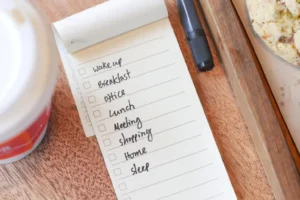
Tip: write your menu on a sticky note or in your phone’s notes app now, while you feel okay. When you’re depleted, deciding what to do is the hardest part, so let past-you make the choice.
The Question Isn’t “Do I Deserve Self-Care?”
You do not have to earn rest by becoming sufficiently exhausted.
You don’t need to complete everything before taking care of yourself.
And self-care isn’t selfish simply because you benefit from it.
The better question is:
“What do I need in order to keep showing up for my life in a healthy and sustainable way?”
Some days, the answer might be exercise.
Another day, therapy.
Another day, boundaries.
Another day, laughter.
And occasionally, the answer really is ordering your favorite food, putting on pajamas at 6:30 p.m., and telling the world:
“We’re closed.”
That counts too.
Self-care doesn’t have to be perfect, profound, expensive, or aesthetically pleasing.
It simply needs to be intentional.
So today, before you finish taking care of everything—and everybody—else, ask yourself one small question:
What would taking care of me look like today?
Then do one thing.
Not ten.
One.
When Self-Care Isn’t Enough
Self-care keeps you running. It isn’t meant to carry a mental health condition on its own. Consider talking with a professional if:
- You’ve kept up the basics and still feel exhausted, low or on edge most days for two weeks or more
- Your sleep or appetite has changed and isn’t settling
- You’ve lost interest in things you used to enjoy
- Work, school or caring for your family is getting harder to manage
- You’re leaning on alcohol, substances or overworking to cope
At Mindful Health, support can start with psychiatry and medication management. Another option is our Intensive Outpatient Program (IOP), which runs about 3 hours a day, 3 to 5 days a week so you can keep working while you get care. The IOP also includes yoga, aromatherapy and nutritionist support, and our Holistic Wellness team offers more ways to care for body and mind. We see clients at five clinics across Texas and through virtual appointments anywhere in Texas. New and expecting moms can reach our Mindful Maternal team.
Ready to talk to someone? Schedule an appointment and our team will check your insurance benefits before your first visit.
If you’re thinking about suicide or worried about your safety, call or text 988 to reach the 988 Suicide & Crisis Lifeline, available 24/7. In an emergency, call 911 or go to the nearest emergency room.
Frequently Asked Questions About Self-Care
Is self-care selfish?
No. Taking care of your sleep, health and limits is what lets you keep showing up for the people who depend on you. Benefiting from something doesn’t make it selfish.
Why is self-care important for mental health?
Regular self-care helps you manage stress before it builds up. NIMH notes it can help you manage stress, lower your risk of illness and increase your energy.
What are the 5 types of self-care?
A simple way to sort it is physical (sleep, food, movement, medical care), emotional (noticing and expressing feelings), social (connection, or space from people), boundaries (saying no), and small, free habits you can do in five minutes.
What are some free self-care ideas?
Take a nap, sit outside, turn off notifications, listen to music, stretch, journal, call someone who makes you laugh, leave work on time or say no to one request this week.
How do I make time for self-care when I’m busy?
Start with one five-minute habit tied to something you already do, like three slow breaths before you open your laptop or a short walk after lunch. Small and repeated beats big and occasional.
How do I build a self-care routine that sticks?
Make a self-care menu with options for 5 minutes, 30 minutes, a few hours and hard days. Write it down while you feel okay, so you don’t have to decide when you’re depleted.
What’s the difference between self-care and avoidance?
Self-care leaves you better off tomorrow. Avoidance numbs today and lets the problem grow. Scrolling for hours or drinking to switch off usually falls into the second group.
Can self-care replace mental health treatment?
No. Self-care supports your mental health, but it isn’t a treatment for depression, anxiety or other conditions. If symptoms last two weeks or more, talk with a licensed clinician.
What does self-care look like for new moms and caregivers?
Often it’s very small: a nap while someone else holds the baby, eating a real meal, or asking for help with one task. If low mood, anxiety or intrusive thoughts don’t ease after the first couple of weeks postpartum, reach out to a perinatal mental health provider such as our Mindful Maternal team.
When should I see a professional instead of trying more self-care?
See a professional when you’re doing the basics and still struggling most days for two weeks or more. The same goes when daily life is getting harder to manage, or when you’re using substances to cope. If you’re in crisis, call or text 988.